info@indiegamejoe.com

Steam refunds aren’t the enemy of small devs, and the policy is worth protecting
Introduction
The conversation around Steam refunds has been all over the place, and I’ve found myself disagreeing with almost everyone, which is always a fun position to be in publicly.
Some of the anger is fair. Watching someone finish your game, praise it, and then refund it is frustrating. But I also think people are getting angry at the wrong part of the problem.
The refund rate at the center of this debate is not what many people think it is, and weakening the policy would not just punish the small number of people abusing it. It could also make players less willing to take a chance on the small, unknown games the policy helps most.
Before I get into all of that, I want to make one thing very clear: this is not an attack on the developer, his game, or anyone who sympathized with his frustration. I understand why he was angry. This is about Steam’s refund policy, the way the numbers have been interpreted, and whether any of the proposed fixes would actually make things better.
The Refunded Review That Started It All
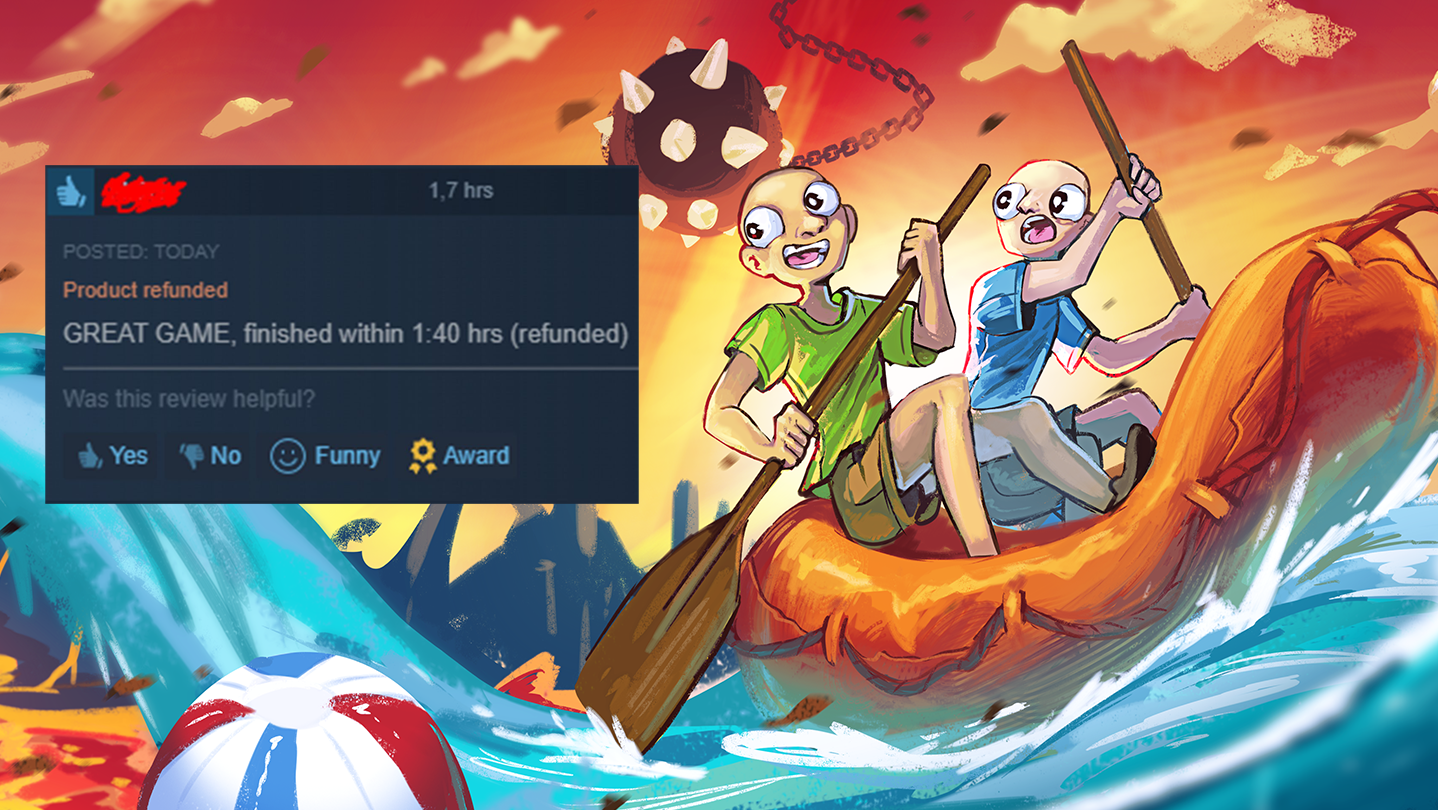
On July 5, Mateo, better known as Zoroarts, the 23-year-old solo developer behind the viral hit Paddle Paddle Paddle, posted a screenshot of a Steam review. The review said, “GREAT GAME, finished within 1:40 hrs,” with the orange “Product refunded” label sitting right above it.
Understandably, he was frustrated. He said he had seen dozens of similar reviews. He also shared that the game had a 21% refund rate, totaling more than 55,000 refunds, and asked Steam to reconsider the policy.
This should not be possible @Steam
Would be cool if you could finally do something about your refund policy… Got dozens of reviews like that and 21% refund rate even though the Reviews are 90% very positive…
Thats over 55,000 Refunds btw… pic.twitter.com/fSiuHjGRnD
— Zoroarts 🦈 Paddle Paddle Paddle OUT NOW (@Zoroarts) July 5, 2026
If you’re not familiar with how Steam refunds work, it’s pretty simple. You can refund any game within 14 days of purchase as long as you’ve played it for less than two hours, no questions asked.
Paddle Paddle Paddle is a short co-op rage game. It’s about £5 at full price, has often been around on sale for around £3, and skilled players can finish it inside that two-hour window. So yes, some people were beating the game, loving it, refunding it, and then bragging about it in reviews.
Naturally, the internet did what the internet does. Within a day, Zoroarts’ post had millions of views, many people were furious at Steam on his behalf, and the takes ranged from “block refunds on completed games” to the “make a game worth keeping” crowd.
The Biggest Mix-Up
It’s important to talk about this in particular because almost every angry post I saw was built around the same misunderstanding. In fairness, it’s not even what Zoroarts said. He mentioned “dozens” of reviews like that and a 21% refund rate as two separate things. But because of the way the post was worded and presented alongside that screenshot, a lot of people came away believing that 21% of buyers had abused the refund policy. That isn’t the case, and I don’t think that’s what he meant either.
The 21% includes every refund combined: netcode complaints, bugs, connection issues, friend groups that never materialized, and people who simply did not enjoy the game. Which is allowed, by the way.
We have no data showing how much of that 21% came from people who finished the game and abused the policy. What we can see is a relatively small number openly admitting to it. Mateo described that group as “dozens” out of 270,000 buyers, while many written refund reviews pointed to genuine problems with the game.
More people may have completed it, refunded it, and stayed quiet. Some surely did. But everything visible suggests they were still a small minority.
What you’re really looking at is a small slice of that 21% doing all of the emotional heavy lifting for the entire discourse. One rare behavior borrowed the weight of a much larger statistic, and millions of people got angry at a number that, as we’re about to see, is well, pretty normal.
And in fairness to Mateo, he’d just watched people openly brag about refunding his game. He was frustrated, and the post came out the way heated posts often do. He’s since said as much himself.
The Part Everyone Agrees On (Including Steam)
A user finishing your game, loving it, and then refunding it while bragging about it in a positive review is poor form. I understand the frustration here, and I am not here to defend that behavior, and Steam isn’t either.
This is the part I genuinely don’t think most people arguing about the policy have even read. Steam’s refund page says, word for word, that refunds are designed to remove the risk from purchasing titles on Steam, “not as a way to get free games,” and that if Valve believes you’re abusing the system, it may stop offering refunds to you. Go read it yourself here.
The rules already agree with Mateo. Beating a game and then refunding it just to get the experience for free is exactly what the policy says refunds are not for, and people who make a habit of doing it may lose their refund privileges.
The problem was never that Steam thinks this behavior is fine. It’s that a small number of people are jerks, and no policy in human history has ever managed to fix that.
But, 21% Is Still Double the Average, Right?
A 21% refund rate sounds brutal until you add some context. The Steam average is around 10%, according to GameDiscoverCo’s survey of nearly 150 developers, but plenty of perfectly healthy games sit well above that. Early Access games alone average around 12%, and half of them sit higher still without anyone writing headlines about it.
Short games also tend to have higher refund rates. That same GameDiscoverCo data shows that, generally, the lower a game’s average playtime, the more refunds it gets. Then add in a viral moment that floods a game with impulse buyers who were never completely sure it was for them in the first place, and the rate can climb even further. Paddle Paddle Paddle also spent a lot of time on sale for around £3, pulling in exactly that kind of crowd.
Stack all of that together, and a 21% refund rate for a viral rage game selling for around £3 is honestly not as shocking as it first sounds. That doesn’t make what the finish-and-refund crowd does okay. I want to be really clear about that. It simply means the number itself is not proof that the system is broken.
And I’m not even the best source on this anymore. Once the dust settled, Mateo himself said that a 20% refund rate is “not super high but rather normal for a rage game.”
His words.
Refunds Don’t Just Protect Buyers, They Create Them
Think about the last time you hovered over the buy button on a game from a dev you’d never heard of. Maybe you weren’t sure it was for you, whether your PC could run it, or whether spending £5 on a gamble felt too risky that month.
What got you over the line?
For many people, it’s the quiet knowledge that if things don’t work out, they can get their money back. The risk feels much lower, so they click, and many of those fence-sitters end up keeping the game. That means the refund policy helps create sales that might never have happened otherwise.
The problem is that devs can’t see those sales.
When a fence-sitter buys your game and keeps it, that purchase looks identical to every other sale on your dashboard. There’s no label saying, “This person only bought because refunds exist.” The policy’s contribution is invisible.
But the cost? That’s RIGHT there in orange. In this case, 55,000 refunds, itemized into one big, scary number you can screenshot and post. Every dev can see what the policy costs without seeing the sales it helped generate. It’s like a shop with a generous returns policy complaining about the cost of returns while having no way to count the customers who only shop there because returning something is easy.
When I said the refund policy may be part of the reason Mateo reached 270,000 sales, that’s what I meant. Some invisible portion of those buyers may have clicked because they knew backing out was free.
Removing risk from a purchase is the policy’s stated purpose. Valve says so on its own refund page, and a meta-analysis of 21 retail studies found that lenient return policies can increase purchases more than returns.
Satisfaction guarantees have worked on this principle forever.
Who’d Actually Lose If Steam Watered It Down
I want to give you a quick thought experiment here. Imagine Steam did what some of the angriest replies wanted and made refunds meaningfully harder to get.
Guess who wins? Big publishers, that’s who.
When buying becomes risky again, people are more likely to spend money where they already have trust, and trust usually flows to names they know. Nintendo doesn’t need a refund policy to convince you to buy a Zelda game. Its reputation IS the safety net, and that reputation took decades and billions of dollars to build.
But who loses?
The unknown solo dev asking strangers to gamble £5 on a rage platformer about paddles. Nobody has any real reason to trust that purchase yet. The refund policy helps bridge that gap by giving unknown devs a level of purchase safety that AAA brands spent decades earning.
Take that away and fence-sitters don’t suddenly get braver. They retreat to the safe names they already know, and the gap between trusted publishers and unknown developers gets wider, with small devs stuck on the wrong side of it.
That’s the strange irony sitting at the center of this whole discourse. The policy so many people were demanding Steam weaken may actually be doing more for devs exactly like Mateo than for the biggest names on the platform.
A year ago, he was an unknown developer asking strangers to trust him.
Then 270,000 of them did.
Are Steam Refunds Pushing Devs Toward Longer Games?
This was valid pushback from a fellow dev, and it deserves a proper answer.
The argument is simple: developers weigh costs and returns before writing a single line of code. If short games come with a refund rate roughly double the average, that puts a thumb on the scale in favor of making longer games. The policy may not force anyone, but it can still shape what gets made through incentives.
That’s fair, but there are two sides to the math.
Yes, short games can face greater refund exposure. They can also cost less, take less time to build, and benefit from the impulse-buy firehose this policy helps power. A £3 game from an unknown dev is much easier to try when the purchase feels risk-free.
So the policy is not simply a tax on short games. It is a tax bundled with a much larger subsidy. Paddle Paddle Paddle absorbed a 21% refund rate and still sold 270,000 copies on a small-scale build. Whatever that is, it certainly is not a disincentive story.
There’s also the fact that players questioned the value of very short games long before Steam introduced refunds. Remember the uproar over Metal Gear Solid V: Ground Zeroes in 2014? It was a roughly two-hour prologue priced at up to $40, and the internet lost its mind over the length. That happened more than a year before Steam refunds existed.
The refund window did not create that concern. It simply made it visible on a dashboard. And if the policy truly pushed developers away from short games, the current wave of short viral co-op games, or “friendslop,” would not exist. Instead, it is thriving under this exact policy.
So the answer is simple: watch what developers actually make, not just what a theory predicts they will make. Right now, they are choosing to make short games everywhere.
The Honest Section, Because the Other Side Isn’t Stupid
Some of you have probably been typing your reply since you read the title, so let’s be honest about the strongest arguments against everything I’ve said.
The biggest one is perspective. I know I’m arguing from a comfortable position. My own game, Don’t Scream, sold hundreds of thousands of copies. Mateo sold 270,000. At that scale, a 20% refund rate is frustrating, but it doesn’t hit quite as hard.
For a first-time dev who made 500 sales at launch, though? It can feel like the whole business. When you have no cushion, every refunded £5 feels like money you had already mentally spent. I’d be lying if I said the math feels the same down there as it does up here.
There’s also the practical side. Steam pays developers monthly and deducts refunds before the money ever reaches them. If you’re short on cash and counting on that launch income, refunds can shrink a payment you badly needed. I understand how much that sucks.
And the abuse problem is real, so I don’t want to wave it away. The most damaging behavior for a short game is someone finishing it and then refunding it. The problem is that it’s almost impossible to catch. Each person leaves behind one ordinary-looking refund, with no larger pattern for Valve to detect. In the data, it looks exactly like an honest refund.
This has been happening for years. Before Your Eyes received the same treatment in 2021: a glowing review followed by a refund. There’s even “refund run” content, with people deliberately speedrunning games inside the refund window.
All of this is true, and I concede every word of it. So why do I still hold my position?
Because the payment issue would exist under any refund policy. Steam would still deduct refunds before paying developers, so while it’s a real cash-flow problem, it isn’t proof that the two-hour policy is broken.
The small-dev argument also flips back on itself. The smaller and more unknown you are, the more you NEED that safety net. Without it, strangers are far less likely to take a chance on you at all, and fewer sales is a much worse outcome than a smaller payout.
That leaves the finish-and-refund problem, but every proposed fix depends on Steam being able to tell an abusive refund from a genuine one. Most of the time, it can’t.
When the Fix Is Worse Than the Problem
Here’s the part I don’t think people fully understand: Steam usually cannot tell whether an individual refund is justified.
The refund form asks for a reason, but it’s self-reported. Nobody gaming the system is going to select, “I beat the game and wanted it for free.” They’ll choose something like “not what I expected,” just like everyone else.
So someone who finished the game and abused the refund window looks, in the data, identical to someone who played for 100 minutes and genuinely hated it. Any rule designed to catch the first person will inevitably hurt the second, and the second group is VASTLY larger.
Block refunds after completion, and finishing a bad game suddenly means giving up your right to a refund. Players may avoid finishing games inside the window, while devs may start delaying or hiding their endings.
Shorten the window for short games, and buyers become more hesitant about the exact games you’re trying to protect. Make the window proportional to the game’s length, and incentivize developers to pad playtime. Have a human judge the intent behind millions of refunds? That simply isn’t feasible.
The one form of abuse Steam can detect is a repeated pattern of buying, finishing, and refunding games. That is already against the rules, and Valve says repeated abuse may result in losing access to refunds.
This is also why I push back when people call the policy “broken.” Broken means failing at its purpose.
Steam’s refund policy exists to protect buyers and reduce the risk of purchasing games from developers they’ve never heard of. By both measures, it works. Remember Battlefield 2042? We were lucky Steam refunds existed then. The policy has protected countless players from buggy releases and launches that promised far more than they delivered.
And on the other side, Mateo’s 270,000 sales show how the same safety net can help unknown developers earn buyers’ trust.
A small minority abusing a policy does not make it broken. Every rule gets abused by someone. The real question is whether it still works for the overwhelming majority. And it clearly does.
What My Own Launch Taught Me About Refunds
I know it’s easy to defend a policy in the abstract when it isn’t your own game, so here’s my experience.
Don’t Scream, which I launched in 2023, was a very similar bet to Mateo’s. It was designed as a short experience from day one, and its entire hook was an “18-minute experience” in a pitch-black forest where, if you scream, you restart. It took about five months to make, so the risk wasn’t huge. But the reward was massive: more than 100,000 copies sold in less than a week, with hundreds of thousands more since.
And yes, refunds were high at launch. It was the same policy then as it is now. The game had bugs and issues, and I’m sure some people finished it, loved it, and refunded it anyway. Those players were unlikely to become my fans or champions, and I wasn’t going to let a handful of them overshadow the hundreds of thousands who tried the game and stayed. The refund policy helped make that possible in the first place.
The refunds turned out to be a launch issue, not a permanent one. We kept adding content and giving people more reasons to come back, and the refund rate gradually decreased.
So when I see a short game with a 21% refund rate, I don’t see a policy failure. I see a trade-off that has already paid off and a developer with a massive opportunity ahead of him.
Even the Best-Sounding Fix Has a Catch
Mateo suggested that Steam display expected playtime on store pages, and in my original thread, I said I’d love to see it. Having thought about it more, I’m no longer sure I agree. The problem is simple: there’s no single, truthful number you could put on that label. Whose playtime would it show?
Paddle Paddle Paddle was designed to last around 3.5 to 4 hours. Speedrunners can finish it in under two, while plenty of reviews show 10, 20, or even more hours. Don’t Scream advertised itself as an “18-minute experience,” yet many players got hours out of it.
Whatever number Steam displays will be wrong for a large portion of buyers. It could put off people who would have loved the game, while anyone who finishes faster than expected may feel the store page “lied” to them. Suddenly, the label creates another reason to request a refund.
And before anyone says, “Just use the average,” I honestly think that may be the most misleading option of all.
From my experience making and playing games, playtime is VERY personal. Steam counts idle time, going AFK, leaving the game running, and replaying it. A handful of players with 100 hours can push the average for a three-hour game closer to eight, causing the label to oversell the experience instead.
New releases create another problem. A brand-new game has no reliable average, so the label would either be empty or based on the first wave of players, often speedrunners and streamers. That’s exactly when a game needs buyer trust the most. And the moment that number starts affecting sales, devs will start optimizing around it.
The more honest version of this feature already exists: review playtimes. Every review shows how long that player spent with the game, giving buyers a real range based on real people instead of one official number pretending to be the answer.
A range gives you context. A single number will always be wrong for someone.
So credit to Mateo for suggesting something constructive instead of simply being angry. But even the best-sounding fix has a catch, which proves the larger point.
The current policy may be blunt, but it keeps beating every alternative people offer.
The Policy Isn’t Perfect, but the Alternatives Are Worse
Steam’s refund policy is imperfect. Some people will abuse it, and short-game developers have every right to find that frustrating. But the 21% figure that started this conversation was never an abuse rate, and a small minority gaming the system does not make the entire policy broken.
Refunds also give strangers the confidence to take a chance on unknown games. Remove that safety net, and many of those buyers simply will not buy at all. If you make short games, keep making them. Build something people want to keep, then give them reasons to come back. That is what turns a viral week into a long tail.
Steam refunds are not the enemy of small developers. For many of us, they are part of the reason strangers are willing to give our games a chance.
And that is a policy worth protecting.
Thanks for reading, and happy gaming.